Your VP wants a list of every company running a competitor’s platform, and they want it by Friday. So the internal debate starts: do you buy a technology user list from a provider, or build one in-house?
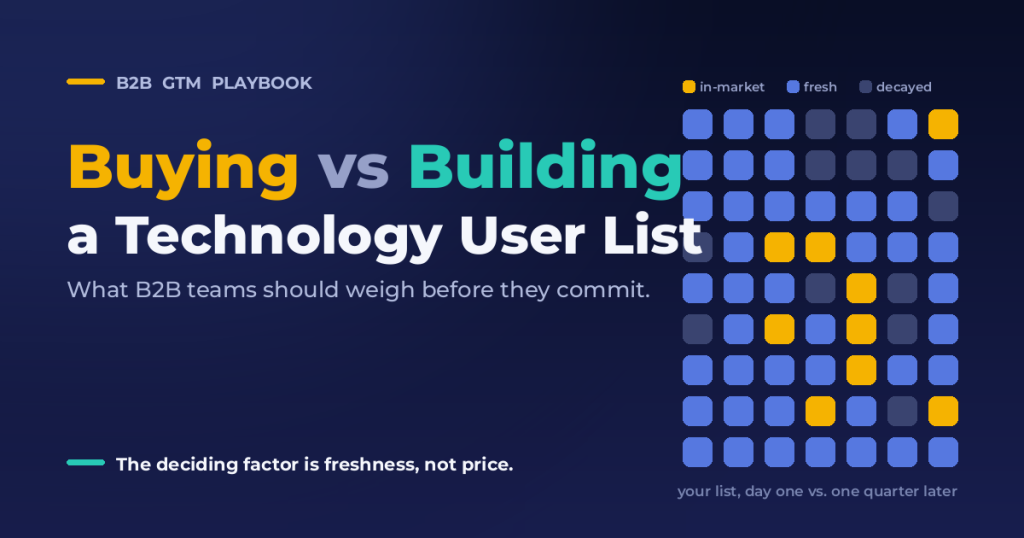
That is the wrong debate. Whichever way you get the list, part of it will be wrong within a quarter. The question that actually matters is not buy or build. It is who can keep the list accurate after day one.
Key Takeaway: A technology user list is a perishable good, not a one-time purchase or a one-time build. Choose the option that keeps the data fresh at the cadence your motion requires, not the one that looks cheaper up front.
Why “Buy or Build” Is the Wrong Frame
The variable that decides this whole question is freshness, not sourcing method. A technology user list is not an asset you acquire once. It is a snapshot of a moving target, and the target moves fast.
Start with the people on the list. HubSpot’s database decay simulation, built on MarketingSherpa research, puts B2B contact decay at roughly 2.1% per month, which compounds to about 22.5% per year.
In high-churn segments, the figure runs far higher: a widely cited Gartner benchmark puts worst-case decay near 70% a year. Cleanlist estimates that roughly 30% of professionals change jobs annually, invalidating their contact details in every database that stores them.
Now add the technology layer on top, because that decays too. Dun and Bradstreet estimates that 20% to 30% of firmographic data goes obsolete each year through acquisitions, rebrands, and closures.
Technology stacks churn even faster: a CRM migration takes three to six months, and the day a company finishes switching from Salesforce to HubSpot, every “Salesforce users” list that still shows them is wrong.
Get a Try Sample Data
Most technographic data collected through web crawling already lags actual adoption by 60 to 90 days, according to accuracy reports compiled by the Cold Email Manifesto.
ZoomInfo research (cited in Salesmotion’s 2026 data-quality analysis) found sales reps spend 27.3% of their time dealing with inaccurate data, roughly 546 hours per rep per year. That is where a stale list actually charges you, long after the invoice or the build sprint is paid for.
The list you argue over this week is a depreciating input, so the only sourcing question worth asking is which approach lets you refresh it fastest.
Whether you buy or build, if the answer is “quarterly, if we get to it,” you have already lost. Everything below flows from that.
What Building a List Actually Costs You
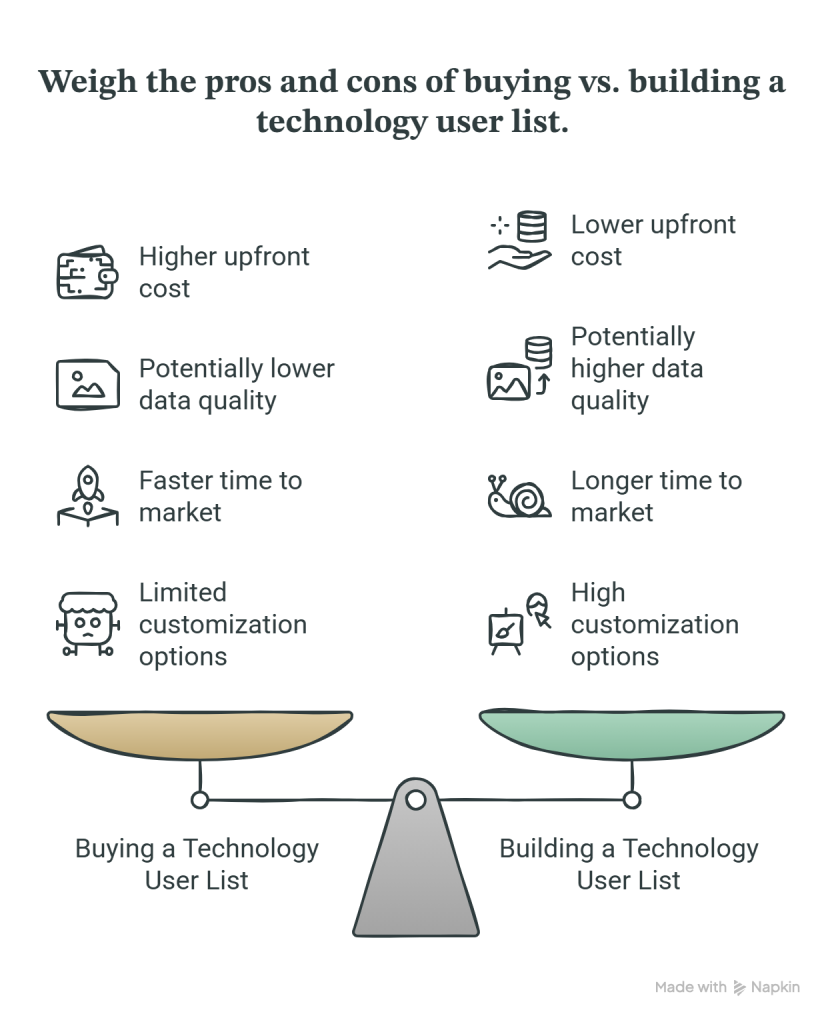
Building is not “point a scraper at some websites.” Building a technology user list that holds up means standing up a multi-source collection and verification operation, then staffing it forever. Most teams badly underestimate the “forever” part.
There is no single source of truth for which software a company runs, so a real build stitches together several detection methods, each with its own blind spot.
Website fingerprinting reads HTML tags, scripts, and DNS records to identify front-facing tools such as analytics and chat widgets.
Job-posting analysis infers the stack from hiring signals, which often surface a tool before it appears on the public site. Licensed partner data and human-curated research fill in the enterprise back office that crawlers never see. You need the blend, because any one method on its own leaves large gaps.
The accuracy of math is unforgiving. Bright Data reports that front-end website technologies can be detected at 90% or better, while backend and internal systems, the expensive CRM, ERP, and data warehouse tools you most want to sell against, land closer to 60% to 70% accuracy.
SparkDBI, citing Gartner’s data-quality research, notes that single-source detection produces materially lower accuracy than multi-source confirmation, which is why serious providers refuse to log a technology as “installed” based on a single signal.
Providers that combine web crawling with human verification and refresh under 90 days typically report 85% to 92% accuracy, and that range drops the moment the verification cadence slips.
Then there is compliance, which is not optional. The moment your technology data is joined to contact details for outreach, GDPR in Europe and CCPA in California apply, and you assume the legal exposure. A fast, accurate list that creates compliance liability is not usable.
Our Data Says (build a comparable check for your own team): run the honest tally before committing. Count the engineering hours to build and maintain collection pipelines, the ongoing verification headcount, the licensed data you still have to buy to cover backend systems, and the legal review. Compare that annual number to a provider contract before you assume building is the frugal option.
Building is a permanent operating commitment, not a one-time project, and it only pays off when the list is a durable competitive edge rather than a commodity you could rent. That distinction is the heart of the decision.
What Buying Gets You, and Where It Breaks
Buying gives you coverage and speed you cannot realistically match on your own, but quality varies so widely between providers that you have to test before you trust. Both halves of that sentence are true, and teams get burned by ignoring the second half.
The coverage case is strong. The technographic data market grew from around $367 million in 2020 to more than $1 billion by 2026, per Prospeo’s market analysis, precisely because in-house teams could not keep pace with detection at scale.
A good provider hands you millions of company records across thousands of technologies on the day you sign, which no internal build can produce in its first year. If your VP needs a Salesforce user list by Friday, buying is the only option that meets the deadline.
The failure modes are just as real. Provider accuracy swings hard by method and by how recently the data was refreshed, and web-scraped lists share the same backend blind spots as a build would.
Company-level data is also not contact-level: knowing that Acme runs Snowflake does you no good if you cannot reach a real, current decision-maker there, and contact records decay at the rates covered above.
One agency running cold email at volume found that 12% to 15% of purchased contacts had already changed roles since the last refresh when cross-checked against LinkedIn.
So, validate before you commit. The cleanest test, recommended in Prospeo’s provider guidance, is the 20-account spot-check: take 20 accounts whose stack you already know, ideally your own customers, run them through the provider, and compare.
If accuracy falls below 80% on accounts you can verify by hand, the provider’s broader database is almost certainly worse.
Never buy a technology user list you have not validated against accounts you already know the truth about. A five-minute spot-check tells you more than any accuracy claim on the vendor’s homepage.
The Five-Factor Build-or-Buy Scorecard
Score your situation on five factors before you commit a rupee or a sprint. Rate each from 1 (strongly favors buying) to 5 (strongly favors building), then read the total. This turns a gut argument into a decision a leader can hand to a report on Monday morning.
- Coverage breadth. Do you need a broad reach across many technologies and geographies, or a narrow, specific slice? Broad needs favors buying. A tight niche you understand deeply is more buildable.
- Freshness requirement. Is your motion timing-sensitive, like competitive displacement keyed to contract-renewal windows, or is a quarterly view acceptable? The tighter the freshness need, the more you should lean on a provider that refreshes continuously rather than a build you will struggle to keep up to date.
- In-house data capacity. Do you have data engineers and a verification function that you can permanently dedicate? No capacity means buy. A staffed data team makes building viable.
- Compliance exposure. Are you targeting EMEA or regulated industries where GDPR and CCPA raise the stakes? Higher exposure favors buying from a provider whose lawful basis and certifications are already in place, unless you have legal support to carry it in-house.
- Time-to-value. Do you need the list this quarter or this week? Urgency favors buying. A long runway makes building plausible.
Add the five scores. A low total (roughly 5 to 12) points to buying. A high total (roughly 18-25) suggests a build could be worth it. Most teams land in the middle, and the middle has a clear answer.
For most B2B teams, the real answer is not buy or build, it is buy the base and build the edge. Rent the broad, commodity coverage from a provider whose freshness and compliance you have verified, then build only the narrow proprietary layer that is genuinely your advantage: the accounts, signals, or stack combinations your competitors cannot easily buy.
Before this framework, teams burn a quarter debating an all-or-nothing choice. After it, they buy coverage in a week and spend their scarce engineering time on the 10% of the list that actually differentiates them.
The Deciding Factor Was Never the Invoice
The build-or-buy argument feels like a budget question, and that framing is exactly what leads teams astray. It is a question of freshness, wearing a budget costume.
Whichever path keeps your technology user list accurate at the speed your buyers move is the path that generates a pipeline.
The other one quietly generates bounces, wasted rep hours, and a sender reputation you spend the next quarter repairing.
That reframes the whole exercise. Ownership of the list matters far less than ownership of the refresh loop. A list you built and cannot maintain is worse than one you rented and validated, because the built one carries the sunk cost that makes teams defend stale data rather than replace it.
Freshness is the moat, and it is a moat you have to keep digging.
Before your next purchase or build sprint, do two things this week. Run the 20-account spot-check on any list you are about to trust, and score your situation honestly against the five factors above.
If the freshness test fails, stop: nothing downstream, no clever sequence, no AI-assisted personalization, survives a list that is already wrong. Get that right first, and the buy-or-build decision mostly makes itself.