
Did you know that MSPs play a pivotal role in technology adoption, shaping decisions that impact millions of businesses globally?
The managed services industry has evolved significantly over the years, and today, MSPs are the driving force behind business technology decisions.
What started as outsourced IT support has now evolved into a strategic ecosystem where
Managed Service
Providers, or MSPs, influence infrastructure decisions, cybersecurity investments, and long-term
technology planning for businesses across the world.
For IT vendors, this shift has changed how growth happens. Selling directly to individual businesses is no longer the only path to expansion. MSPs now sit between technology vendors and end customers, acting as advisors, implementers, and long-term service partners. Their recommendations often determine which platforms, tools, and infrastructure solutions get adopted at scale.
This report examines the current state of the managed services industry, how MSPs have evolved, what defines a mature provider, and where the strongest regional opportunities exist today.
More importantly, it helps vendors understand why identifying the right MSP partners has become essential for building scalable channel ecosystems in 2026 and beyond.
Download Free Sample DataUnderstanding the Managed Services Industry
An IT vendor that partners with a leading MSP can witness 30% increase in market reach within the next six months. How? By aligning with the right MSP who understands their needs.
It is important to study how the industry works before expecting growth to happen quickly. The managed services industry did not grow overnight. Its expansion is closely tied to the increasing complexity of modern IT environments. Businesses today operate across cloud platforms, remote work environments, integrated applications, and security frameworks that require continuous monitoring and optimization.
Managing this internally has become expensive and difficult. Skilled IT talent is limited, security threats are increasing, and downtime has a direct financial impact. As a result, organizations increasingly rely on MSPs to manage technology operations through ongoing service agreements rather than one-time engagements.
This shift has fundamentally changed the role of IT outsourcing. Companies are no longer outsourcing only technical support. They are outsourcing responsibility for performance, reliability, and security outcomes. MSPs now operate as long-term technology partners rather than external support teams.
For vendors, this means technology adoption rarely happens in isolation. MSPs evaluate solutions based on how well they fit into ongoing service delivery models. A solution that works well for a single business may not be suitable for an MSP managing hundreds of environments simultaneously. Understanding this distinction is the first step toward building meaningful partnerships within the MSP ecosystem.
As IT outsourcing trends in 2026 continue to favor operational efficiency and predictable costs, MSPs are becoming gatekeepers for technology adoption across mid-market and enterprise segments.
IT Outsourcing Trends Shaping MSP Growth in 2026
The continued growth of MSPs is driven by broader changes in how organizations approach technology ownership and management. Understanding these trends helps vendors anticipate where demand is moving next.
Subscription-Based IT Consumption
Businesses increasingly prefer predictable operational expenses over large capital investments. Managed services allow organizations to access enterprise-level infrastructure without maintaining internal expertise.
This aligns closely with vendor subscription models, creating a natural partnership between software providers and MSP service delivery.
Cybersecurity Skills Shortage
The global shortage of cybersecurity professionals has pushed organizations toward outsourced security management. MSPs are expanding into managed detection, compliance consulting, and advisory services to fill this gap
As MSPs take on more responsibility for security outcomes, their influence over vendor selection continues to grow.
SMB Digital Transformation
Small and mid-sized businesses are adopting advanced technologies faster than before. MSPs act as implementation and management partners, standardizing solutions across multiple clients. For vendors, this provides scalable access to growing markets through a single partnership channel.
These trends reinforce why MSP relationships have become central to vendor growth strategies rather than secondary sales channels. But while MSPs are crucial to modern tech adoption, they are facing significant challenges that impact their decisions. Let's take a closer look.
Challenges MSPs Face Today
For IT vendors, understanding MSPs' challenges isn't just market insight — it's a crucial knowledge base that drives sales growth. These hurdles directly affect their decision-making on what products and services to adopt.
Talent Shortages in Cybersecurity & Cloud Management
One of the biggest challenges is talent availability. Skilled professionals in cybersecurity, cloud management, and infrastructure optimization remain difficult to hire and retain. MSPs must deliver high-quality services with limited human resources, which increases reliance on automation and integrated tools.
Increasing Customer Expectations for 24/7 Support
Customer expectations are also rising. Businesses expect continuous uptime, rapid response times, and proactive problem resolution. This requires MSPs to maintain visibility across multiple environments without increasing operational workload.
Pressure to Maintain Healthy Profit Margins
Maintaining healthy MSP profit margins is another challenge. Providers must balance competitive pricing with growing operational costs. Tools that increase efficiency or reduce manual effort are therefore prioritized over solutions that introduce additional complexity.
Tool Sprawl from Multiple Disconnected Platforms
Tool fragmentation also creates challenges. Many MSPs operate with multiple disconnected platforms, leading to inefficiencies and operational friction. Vendors that simplify workflows or integrate into existing ecosystems gain stronger adoption.
These operational realities explain why MSPs evaluate vendors differently from end customers. Adoption decisions are based on efficiency, scalability, and long-term service impact rather than individual product features.
Why MSPs Have Become Critical Channel Partners for IT Vendors
Many vendors still approach growth through traditional direct sales models. However, customer acquisition costs continue to rise, and businesses increasingly depend on trusted advisors when making technology decisions. This is where MSPs have gained strategic importance.
MSPs maintain long-term relationships with clients. They manage infrastructure daily, understand operational challenges, and recommend solutions that improve efficiency or reduce risk. Because of this trust, their technology recommendations carry significant weight.
A single MSP can influence dozens or even hundreds of purchasing decisions each year. For vendors, this creates an opportunity to scale through partnerships rather than individual sales cycles. Instead of acquiring customers one by one, vendors gain access to entire customer portfolios managed by MSPs.
However, MSP partnerships only work when alignment exists. Providers prioritize solutions that reduce operational complexity, integrate with existing tools, and support recurring service delivery. Vendors that fail to understand MSP operational realities often struggle to gain adoption even when their products are technically strong.
This is why ecosystem visibility matters. Vendors increasingly rely on structured resources such as an MSP Email List or a well-organized Managed Service Providers Directory to identify providers that match their technology focus, service level, and regional priorities.
Targeted engagement allows vendors to focus on partnerships that create long-term value instead of broad outreach with limited results.
The MSP Maturity Model: Understanding Provider Evolution
Not all MSPs operate at the same level. Some are still transitioning from traditional IT services, while others function as strategic technology advisors influencing enterprise decisions. Understanding this maturity progression helps vendors approach partnerships more effectively.
Reactive IT Service Providers
At the earliest stage, providers operate in a reactive model. Revenue is generated by resolving problems after they occur. Automation is limited, and service delivery depends heavily on manual intervention.
Technology adoption at this level focuses on affordability and simplicity. Vendors targeting this segment typically position solutions as tools that reduce workload or improve response times. While partnerships at this stage may generate volume, long-term scalability is often limited.
Managed Services Operators
As providers mature, they move toward proactive service delivery. Monitoring tools, standardized service packages, and recurring contracts become common. Efficiency becomes more important than one-time project revenue.
At this stage, MSPs begin evaluating vendor solutions based on scalability. Integration with existing workflows becomes a deciding factor. Vendors that align with operational processes often become long-term components within the MSP service stack.
Strategic MSPs
Strategic MSPs operate beyond operational support. They guide customers through infrastructure planning, cloud adoption, and cybersecurity strategy. Services often include advisory roles, compliance support, and long-term technology planning.
These providers have significant influence over vendor selection. Technology decisions are made based on business outcomes rather than feature comparisons. Vendors working with strategic MSPs often benefit from higher-value deployments and longer customer lifecycles.
Mature & Enterprise-Level MSPs
Top-tier MSPs operate with high levels of automation and standardized service delivery. Many support multi-region clients and offer white-label IT services. For vendors, these MSPs represent high-impact partnerships — but expectations are higher; solutions must integrate seamlessly and support multi-client management.
For vendors, these MSPs represent high-impact partnerships. However, expectations are higher. Solutions must integrate seamlessly, support multi-client management, and contribute to efficiency rather than increasing operational overhead.
Understanding maturity levels allows vendors to prioritize engagement and approach the MSP ecosystem with clarity instead of treating all providers the same.
Whether you're targeting early-stage MSPs or mature, enterprise-level providers, TechnologyUserLists gives you access to tailored, verified data to guide your outreach strategy.
Understanding the Global MSP Landscape: USA vs EMEA Markets
The MSP ecosystem is global, but growth patterns vary significantly across regions. Vendors that understand regional differences can approach partnerships more strategically.
🇺🇸 United States: Scale & Specialization
The USA remains the largest and most mature MSP market. High cloud adoption, strong cybersecurity awareness, and a large SMB ecosystem have contributed to rapid expansion. Many top MSP companies in USA operate with specialized service offerings focused on specific industries or technologies.
US MSPs tend to adopt new technologies quickly when operational benefits are clear. However, competition among vendors is also higher, which makes targeted engagement essential. Vendors that approach providers with clear operational value propositions tend to see better partnership outcomes.
Largest Global MSP Market🌍EMEA: Compliance-Driven Growth
The EMEA region is experiencing steady MSP growth driven by regulatory requirements and increasing demand for compliance-focused services. Businesses often rely on MSPs to navigate regional data protection requirements while maintaining operational continuity.
MSPs in this region often prioritize stability and long-term vendor relationships. Vendors entering EMEA markets benefit from precise targeting and relationship-focused engagement strategies rather than broad outreach approaches.
Understanding these regional dynamics helps vendors allocate resources effectively and build partnerships aligned with local market realities.
Fastest-Growing Compliance MarketTechnology Stack of a Top-Tier MSP
To successfully partner with MSPs, IT vendors must first understand the underlying technology stack that powers their operations:
Core Operational Platforms
Most MSPs rely on centralized management systems that allow technicians to monitor and manage multiple customer environments simultaneously. Remote monitoring platforms and service automation tools form the backbone of daily operations.
Automation is not optional. It determines profitability. Vendors whose solutions integrate easily into these environments reduce friction and increase adoption potential. Solutions that require additional manual effort are often rejected regardless of feature strength.
Security and Compliance Infrastructure
Cybersecurity has become one of the fastest-growing service areas for MSPs. Businesses expect providers to manage threat monitoring, vulnerability assessments, and compliance requirements as part of ongoing services.
This creates demand for technologies that can scale across multiple environments without increasing complexity. Vendors that simplify security management while improving visibility naturally align with MSP operational priorities.
Cloud and Infrastructure Management
Cloud adoption continues to drive MSP growth. Providers manage hybrid infrastructures, optimize cloud usage, and ensure continuity across distributed systems. Infrastructure management now includes performance monitoring, backup strategies, and cost optimization.
Because MSPs operate across multiple customer environments, efficiency becomes the central decision factor. Vendors that enable simplified management across environments often gain stronger long-term partnerships.
Why IT Vendors Need Accurate MSP Data to Build Channel Programs
Building a successful MSP channel program requires more than broad marketing campaigns. Vendors need accurate, segmented, and up-to-date data to reach decision-makers within MSP organizations. Without reliable data, vendor outreach becomes inefficient and difficult to scale.
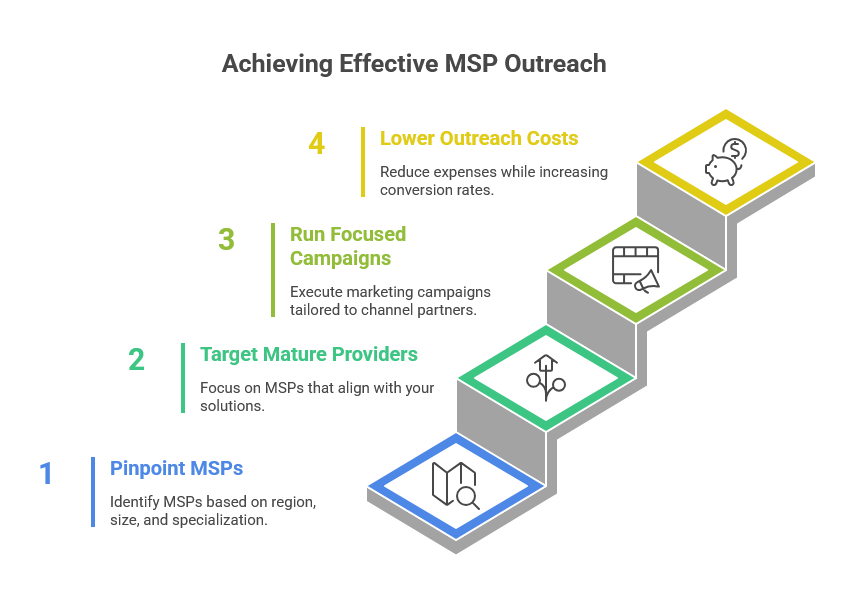
An effective MSP Email List enables vendors to:
Identify MSPs by region, size, and specialization
Target mature providers aligned with their solutions
Run focused channel partner marketing campaigns
Reduce outreach costs while improving conversion rates
Similarly, a well-structured Managed Service Providers Directory helps vendors map the ecosystem and identify partnership opportunities across regions. Without reliable data, vendor outreach becomes inefficient and difficult to scale.
How TechnologyUserLists Supports Vendor Growth in the MSP Ecosystem
TechnologyUserLists helps enterprise vendors connect with verified MSPs globally through structured and continuously updated data resources. Instead of generic outreach, IT vendors gain access to ecosystem intelligence that powers targeted, effective channel programs.
Our MSP Data Resources Include:
Everything you need to identify, reach, and convert the right MSP partners at scale.
This allows vendors to build stronger channel relationships, accelerate partner onboarding, and expand into new markets with confidence.
The Future of the Managed Services Industry
The MSP industry is moving toward deeper specialization and strategic advisory roles. MSPs are no longer just service providers. They are becoming technology enablers that influence infrastructure, security, and cloud decisions for businesses worldwide.
For IT vendors, this creates a clear opportunity. The vendors that succeed in the next phase of growth will be those that treat MSPs as long-term partners rather than transactional resellers.
Understanding MSP maturity, technology needs, and regional dynamics is the first step. The next step is connecting with the right providers through reliable data and structured outreach.
As the managed services ecosystem continues to expand, vendor success will increasingly depend on how effectively they engage with the MSP community and build scalable partner networks powered by accurate intelligence and targeted engagement strategies.
Conclusion: The Strategic Opportunity for IT Vendors
The managed services industry has evolved into a strategic layer within the global technology ecosystem. MSPs now influence infrastructure decisions, cybersecurity strategies, and long-term technology adoption across businesses of all sizes.
For IT vendors, this creates a clear opportunity. MSP partnerships provide scalable access to markets, recurring revenue potential, and stronger customer retention through managed relationships. But here Success depends on understanding how MSPs operate, what challenges they face, and how maturity levels influence technology decisions.
Vendors that approach MSP engagement strategically are better positioned to build sustainable partner ecosystems. Identifying the right data providers becomes the foundation of this process.
TechnologyUserLists supports vendors in this effort by providing structured ecosystem visibility through a targeted MSP Email List.
By enabling precise outreach and informed partner identification, vendors can move beyond broad marketing efforts and focus on building meaningful relationships within the rapidly expanding managed services landscape.
